WhyShoweringBeforeSwimmingLessonsIsSoImportant

Summary
- Showering removes oils and bacteria, protects the pool, and prevents irritations.
- Without showering, the pool becomes contaminated with bacteria causing skin and eye problems.
- A short shower saves water, improves water quality, and prevents slippery pool floors.
Accurately tracking swimming lesson progress per student and group is important for a structured learning process. Both swimming instructors and parents need clear and up-to-date information about swimmers' development.
In this article, we discuss how a digital tracking system can help register swimming lesson progress. We cover which data is relevant, how to record it clearly, and the benefits this offers for planning and communication within swim schools.
Additionally, practical methods are addressed to efficiently manage both individual and group data. This creates a clear picture of progress and allows lessons to be better tailored to the needs of the swimmers.
1. Importance of registering progress
Registering swimming lesson progress is essential for a structured learning process. In this chapter, we discuss why tracking progress is important, the benefits it offers for both students and instructors, and how it positively affects lesson quality and motivation.
Why tracking progress is important
Tracking the progress of each swimming student provides clarity about the learning process. Instructors can see exactly which skills have already been mastered and where more attention is needed.
This makes it possible to better tailor the lesson program to the individual needs of the student. Additionally, it helps to make development over time transparent, which is important for a structured build-up of swimming skills.
Benefits for students and instructors
For students, progress tracking provides insight into their own development. They see which steps they have already taken and what they can still improve.
Instructors benefit because they can plan their lessons more effectively and give more targeted feedback. This promotes a personal approach and makes it easier to celebrate moments of success.
Effect on lesson quality and motivation
Good progress registration contributes to higher lesson quality. Instructors can better differentiate and respond to the needs of the group and individual students.
It also encourages students to stay motivated because they can see concrete goals and achieved results. This positively influences enthusiasm and engagement during swimming lessons.
What is Zwemlesmaatje?
Zwemlesmaatje is an independent app that lets you track, assess, and celebrate swimming progress — whether you are a parent, adult swimmer, or instructor. You are not dependent on the swim school but keep control yourself.
For parents, the app offers a clear learning path of 7 levels (from Red to Gold) with 86 exercises. You assess each exercise with a simple scoring system (0 to 6) and receive a personal swimming certificate for each achieved level. This way, you can see at a glance where your child stands and what still needs work.
Adults who want to learn (better) swimming use Zwemlesmaatje discreetly and without group pressure. The app provides structure, breaks the learning process into manageable steps, and helps overcome insecurity. You train at your own pace, whenever it suits you.
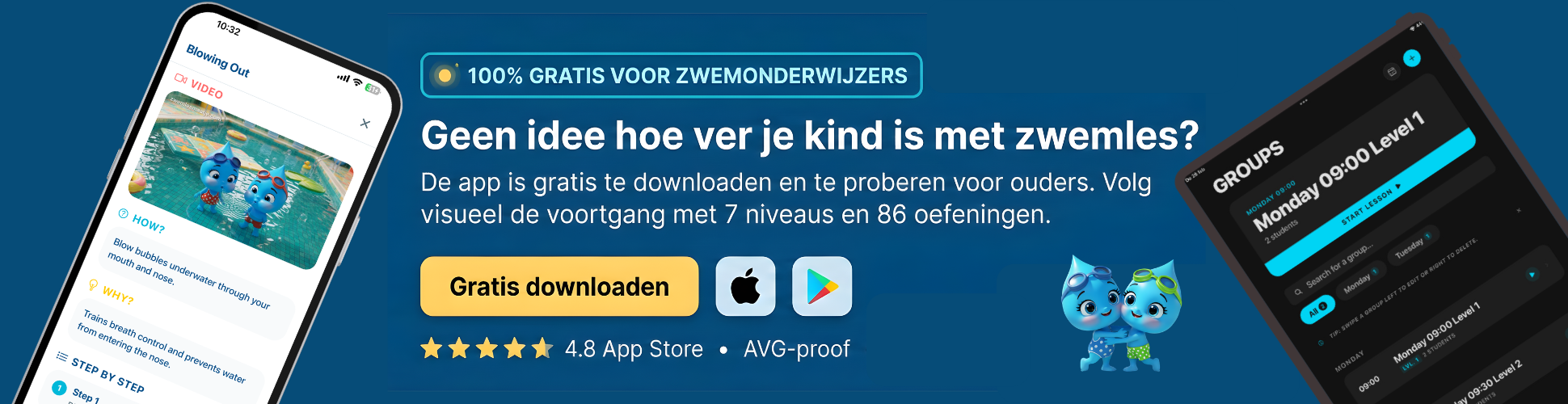
Swim schools and instructors use Zwemlesmaatje completely free as a digital system for student administration, schedules, and progress. Parents see their child's development in real-time — without you having to do any work. A handy Marketing Toolbox also helps you create professional flyers, social media posts, and certificates.
Discover now how Zwemlesmaatje supports your swimming journey.
2. Basic elements of registration
In this chapter, we discuss which data is important to register during swimming lessons. We explain the difference between individual and group data. Additionally, we cover how to recognize and record different progress levels.
Which data to register
When registering swimming lesson progress, it is essential to record relevant data. Think of personal details such as name, age, and contact information. Additionally, note which swimming skills a student has mastered, for example floating, breathing, or swimming strokes.
The student's level and obtained diplomas are also included. By systematically keeping this data, a clear overview of development per student emerges.
Individual versus group data
Individual data provides insight into the personal progress of each swimmer. This helps instructors tailor lessons. Group data offers an overview of the level and progress of the entire group.
For example, a swim school can see which skills need extra attention for the group as a whole. Combining both data types ensures a balanced teaching approach.
Recognizing different progress levels
Distinguishing progress levels helps to better track students' development. For example: beginner, advanced, and diploma level. Each level has specific skills and goals to be achieved.
By recognizing and recording these levels, instructors can give targeted feedback. This makes it easier to determine the next steps needed for each student.
3. Methods for progress registration
In this chapter, we discuss three ways to register swimming lesson progress. We look at manual methods, digital software, and the benefits of standardized systems. This gives you insight into which approach best fits your situation.
Manual registration as an option
Manual registration is a traditional method where instructors note progress on paper or in simple spreadsheets.
This approach is low-threshold and requires no special equipment or software.
The downside is that it can be time-consuming and errors occur more easily, especially with larger groups.
Still, it can be a practical solution for small groups or individual lessons, especially if few technical resources are available.
Digital registration with software
Digital registration with software offers an efficient way to track progress per student and group.
With special swimming lesson apps, instructors can easily record skills and diplomas and view progress.
These systems often also provide reports and communication options with parents, increasing involvement.
Additionally, digital registration reduces administrative errors and saves time updating data.
Benefits of standardized systems
Standardized systems ensure a uniform way of registering within a swim school or instructor group.
This makes it easier to compare and analyze progress, both individually and per group.
It also helps in planning follow-up lessons and identifying students who need extra attention.
By using fixed criteria and clear levels, more transparency arises for both instructors and parents.
4. Practical tips for groups
In this chapter, we discuss how to keep the progress of swimming groups clear. We cover grouping, communication with parents and students, and efficiently tracking group data. This gives you practical tools for a structured approach.
Group division and progress monitoring
A clear group division helps to monitor students' progress well. Divide swimmers based on their level and age so instructors can give targeted attention. Use digital tools to track skills achieved per group. This way, you quickly see which group needs extra practice.
By regularly evaluating group division, you can timely move students to an appropriate level. This prevents swimmers from staying too long in a group or moving on too quickly. A clear division contributes to efficient lesson planning and better guidance.
Communication with parents and students
Clear communication with parents and students is essential for a smooth swimming journey. Inform parents regularly about group progress and individual performance via digital reports. This strengthens trust and encourages involvement in the learning process.
Use simple language and concrete examples to make progress clear. For example: "Your child now masters backstroke and is working on breathing technique." This way, parents know exactly where their child stands and what the next step is.
Efficiently tracking collective data
Efficiently tracking collective data saves time and prevents errors. Use digital systems that automatically collect and clearly present group results. This way, you always have current information at hand.
An example is registering attendance and obtained diplomas per group. This makes it easy to spot trends and adjust lesson content. It also helps in planning group activities and preparing reports.
5. Next steps after registration
After registering swimming lesson progress, it is important to use the collected data well. This chapter discusses how to analyze the data, plan follow-up lessons, and report results to stakeholders. This ensures a structured approach that supports the learning process.
Analyzing registered data
The registered progress data offers valuable insights into each student's development. By analyzing this data, you can see which skills are well mastered and where extra attention is needed. This helps to better tailor the lesson program to individual needs. An example is identifying students who struggle with breathing techniques so targeted practice can be done.
Additionally, analyzing group data provides an overview of general progress. You can determine whether the group's pace is appropriate or if adjustments are needed. Regularly evaluating this data contributes to more efficient and effective swimming lesson planning.
Planning follow-up lessons
Based on the analysis, you can plan follow-up lessons that align with current progress. This means you can adjust lessons to the learning needs of individual students or groups. For example, by scheduling extra practice sessions for specific skills or applying differentiation within the group.
A practical step is setting learning goals for the upcoming period. This makes it clear for both instructors and parents what is expected. Planning follow-up lessons with concrete goals increases motivation and learning outcomes.
Reporting to stakeholders
Reporting progress to parents, students, and fellow instructors is an important part of the process. Clear and regular communication ensures involvement and transparency. For example, by sharing progress reports via an app or during a conversation after the lesson.
Reports can also be used to celebrate successes and discuss points of attention. This strengthens trust and encourages a positive learning environment. Ensure the information is understandable and matches the expectations of the recipients.

Summary
Summary of digitally tracking swimming lesson progress
Registering swimming lesson progress is important for a structured learning process. It provides insight into which skills students have mastered and where extra attention is needed.
By systematically recording personal and group data, a clear overview of development per student emerges. This helps to better tailor the lesson program.
Why a digital tracking system helps
A digital tracking system makes it easy to clearly divide swimming groups and track progress per group. This allows instructors to give targeted attention and move students timely to an appropriate level.
Analyzing collected data offers valuable insights for efficient swimming lesson planning. This contributes to more effective guidance and better communication with parents and students.
Various registration methods are possible, but digital systems offer advantages such as fewer errors and time savings. This is especially useful with larger groups.
By digitally tracking swimming lesson progress, the development of each student becomes transparent and the learning process is better supported.
Dear reader, this blog post was about registering swimming lesson progress per student and group.
We would love to hear if you have experience with digitally tracking swimming lessons. Feel free to leave a comment below this article.
You can try Zwemlesmaatje for free via https://zwemlesmaatje.com. We wish you much success in keeping track of swimming lesson progress.

Bob van Soest
As an expert in operating sports facilities (such as swimming pools) and developer of, among others, Zwemlesmaatje.com, I am passionately committed to making swimming lessons simpler, more fun and more insightful for parents, swimming instructors and everyone who wants to learn to swim.
Frequently Asked Questions
Related articles

Discover Zwemlesmaatje
The all-in-one app for swimming lesson progress. For parents, swim schools, and adult swimmers.